
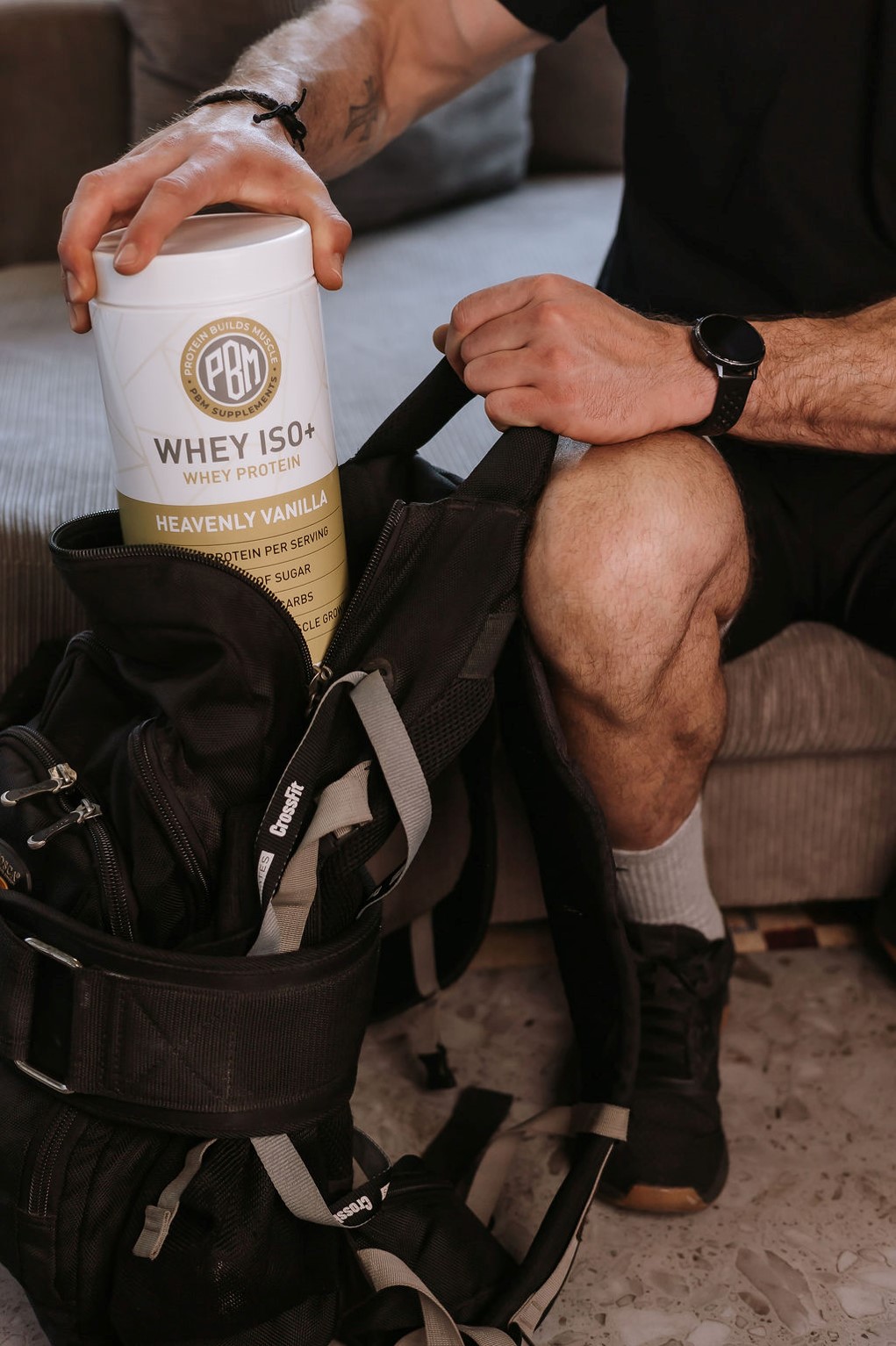
If your goal is to build lean muscle, you probably spend a lot of time
thinking about your training — how often you should train, how heavy you
should lift, and which exercises you should be doing.
But what happens outside the gym is just as important.
Resistance training provides the stimulus that tells your body to adapt.
Your body then needs sufficient energy, nutrients and, importantly,
protein to support the repair and growth of muscle tissue.
So, how important is protein for building muscle, how much do you actually
need, and does it matter when you eat it?
Let’s look at what the research says.
Why Is Protein Important for Building Muscle?
Protein is made up of amino acids, often described as the building blocks
of protein in the body.
When you perform resistance exercise — whether that’s weight training,
CrossFit, HYROX or strength training — it creates a stimulus for your
muscles to adapt.
Both resistance exercise and consuming protein stimulate
muscle protein synthesis (MPS), the process through which
the body produces new muscle proteins (Jäger et al., 2017).
Think of training as sending your body the message that it needs to become
stronger. Protein provides some of the nutritional building blocks required
to help it respond to that message.
This is why simply eating more protein without training isn’t a shortcut to
building muscle. The combination of
progressive resistance training, adequate protein intake, sufficient
overall nutrition and recovery
is what matters.
How Much Protein Do You Need to Build Lean Muscle?
The standard protein requirement for the general population shouldn’t
necessarily be viewed as the optimal amount for someone who trains regularly
and wants to build muscle.
The International Society of Sports Nutrition recommends approximately
1.4–2.0 grams of protein per kilogram of body weight per day
for most exercising individuals looking to build or maintain muscle
(Jäger et al., 2017).
A major systematic review and meta-analysis by Morton et al. (2018),
involving 49 studies and 1,863 participants, found that protein
supplementation enhanced gains in muscle mass and strength during prolonged
resistance training.
Their analysis found that increases in fat-free mass tended to plateau at a
total daily protein intake of approximately
1.6 g/kg/day, although individual requirements can vary.
What Does 1.6 g/kg Look Like?
| Body Weight | Protein at 1.6 g/kg/day |
|---|---|
| 60 kg | 96 g |
| 70 kg | 112 g |
| 80 kg | 128 g |
| 90 kg | 144 g |
| 100 kg | 160 g |
These numbers aren’t a rule that everyone needs to follow exactly. Your
requirements can vary according to your training volume, age, overall
energy intake, goals and individual circumstances.
Protein Isn’t Just About Your Post-Workout Shake
One of the most persistent ideas in fitness is the so-called
“anabolic window”: the belief that you need to consume
protein immediately after finishing your workout or you’ve somehow missed
your opportunity to build muscle.
The reality is more nuanced.
Protein around your training session can certainly be useful, but your
total protein intake across the entire day is extremely
important.
Research reviewed by the International Society of Sports Nutrition suggests
that consuming high-quality protein in servings of roughly
20–40 g, or approximately
0.25 g/kg body weight, can effectively stimulate muscle
protein synthesis (Jäger et al., 2017).
Research discussed by sports nutrition scientist Professor Asker Jeukendrup
also highlights the importance of looking beyond total daily intake and
considering how protein is distributed across meals (Jeukendrup, 2016).
Rather than eating very little protein for most of the day followed by one
enormous protein-heavy dinner, it can therefore be practical to include
quality protein sources across several meals.
Breakfast, lunch, dinner and snacks all represent opportunities to
contribute towards your daily protein intake.
What Are the Best Sources of Protein?
You don’t have to live on chicken breasts and protein shakes.
There are plenty of protein-rich foods that can contribute towards your
daily intake, including:
- Eggs
- Chicken
- Lean beef
- Fish
- Milk and yoghurt
- Cottage cheese
- Legumes and pulses
- Tofu and other soy foods
- Whey protein
Different protein sources have different amino-acid profiles and rates of
digestion, which is one reason variety within your diet is useful.
Whey protein is particularly popular among active people because it provides
high-quality protein in a convenient form. But it should be thought of as
exactly that:
a convenient way to supplement your diet, rather than a
replacement for a balanced diet.
Do You Actually Need a Protein Shake?
No.
You can absolutely meet your protein requirements through food.
But there’s a difference between possible and practical.
If you need 120–150 g of protein per day, for example, consistently reaching
that amount through normal meals can sometimes be difficult — particularly
when you’re working, travelling, training or simply don’t feel like
preparing another protein-rich meal.
A whey protein shake can make hitting your daily protein target
significantly more convenient.
A quality whey protein can be useful after training, with breakfast, between
meals or at other times when getting a protein-rich whole-food meal isn’t
practical.
That’s the philosophy behind
PBM Supplements: Protein Builds Muscle.
PBM Whey Protein was created to offer a convenient, high-quality source
of protein without making nutrition unnecessarily complicated.
The goal isn’t to replace real food. It’s to make getting enough quality
protein a little easier.
Protein Alone Won’t Build Muscle
This is an important point.
You cannot out-supplement poor training, inadequate recovery or an
unbalanced diet.
The research shows that resistance training itself is the primary stimulus
for increases in muscle mass and strength. Protein helps support and
optimise the body’s adaptation to that training (Morton et al., 2018).
Progressive Resistance Training
Provides the stimulus your muscles need to adapt.
Adequate Protein
Supplies the essential amino acids required by the body.
Sufficient Nutrition
Provides energy and nutrients to support training and recovery.
Sleep & Recovery
Give your body an opportunity to repair and adapt.
Consistency
Allows all of these elements to work together over time.
The Bottom Line
If you want to build lean muscle, training hard is only part of the
equation.
Getting enough protein consistently gives your body the amino acids it needs
to support muscle protein synthesis, repair and adaptation following
resistance training.
For most active adults undertaking resistance training, research suggests
that somewhere around
1.4–2.0 g of protein per kilogram of body weight per day
is an appropriate range, with approximately
1.6 g/kg/day being a useful evidence-based reference point
for supporting muscle gain (Jäger et al., 2017; Morton et al., 2018).
You don’t need to become obsessed with numbers, however.
Train consistently. Eat a balanced diet. Include quality protein sources
throughout the day. Recover properly.
And when getting enough protein from food isn’t convenient, a quality whey
protein shake can help bridge the gap.
A Note on Individual Nutrition
Protein requirements can vary according to age, training load, health,
dietary preferences and individual goals. If you’re unsure about your
nutritional requirements, consider consulting a registered dietitian for
personalised advice.
References
Jäger, R., Kerksick, C.M., Campbell, B.I., Cribb, P.J., Wells, S.D.,
Skwiat, T.M., Purpura, M., Ziegenfuss, T.N., Ferrando, A.A., Arent, S.M.,
Smith-Ryan, A.E., Stout, J.R., Arciero, P.J., Ormsbee, M.J., Taylor, L.W.,
Wilborn, C.D., Kalman, D.S., Kreider, R.B., Willoughby, D.S., Hoffman,
J.R., Krzykowski, J.L. and Antonio, J. (2017).
International Society of Sports Nutrition Position Stand: protein and
exercise.
Journal of the International Society of Sports Nutrition, 14, Article 20.
doi:10.1186/s12970-017-0177-8.
Jeukendrup, A. (2016).
Time to rethink the protein intake guidelines for athletes?
MySportScience, 16 November.
Morton, R.W., Murphy, K.T., McKellar, S.R., Schoenfeld, B.J., Henselmans,
M., Helms, E., Aragon, A.A., Devries, M.C., Banfield, L., Krieger, J.W.
and Phillips, S.M. (2018).
A systematic review, meta-analysis and meta-regression of the effect of
protein supplementation on resistance training-induced gains in muscle
mass and strength in healthy adults.
British Journal of Sports Medicine, 52(6), pp. 376–384.
doi:10.1136/bjsports-2017-097608.
Great info!
I love to add cottage cheese to my scrambled eggs as additional protein!